.png)
What Is GEO? Generative Engine Optimisation Guide for Australian Businesses
Here's a number that should stop you in your tracks: 60% of Google searches now end without a single click to any website, Bain & Company, 2026.
Not a rumour. Not a prediction. A present day reality.
And it's only going to accelerate. As AI powered platforms like ChatGPT, Google AI Overviews, Perplexity, and Microsoft Copilot take over the way people find information, the rules of digital visibility have fundamentally shifted. Ranking on Page 1 of Google is no longer the finish line, it's barely the starting line.
Enter Generative Engine Optimisation (GEO), the discipline that separates the Australian businesses getting cited in AI answers from those who've quietly gone invisible.
This is the most complete guide to GEO you'll find, written from an SEO practitioner's perspective, tailored specifically for the Australian market. Let's get into it.
What Is Generative Engine Optimisation (GEO)?
Generative Engine Optimisation (GEO) is the practice of structuring, optimising, and positioning your content and brand authority so that AI powered platforms, such as ChatGPT, Google AI Overviews, Perplexity, Microsoft Copilot, Google Gemini, and emerging AI agents, select, cite, and recommend your content when generating answers to user queries.
In plain terms: GEO is about becoming the source that AI trusts enough to quote.
The term was formally introduced in academic research in 2024, when researchers from Princeton University, Georgia Tech, and IIT Delhi published a landmark paper establishing GEO as a discipline. Their findings demonstrated that applying GEO methods can boost content visibility in AI generated answers by up to 40%.
By 2025 and into 2026, GEO had moved from academic theory to boardroom priority, with 32% of digital marketing leaders declaring it their top strategic initiative for 2026.
Where traditional SEO optimises for a click from a ranked list, GEO optimises for a citation inside a synthesised answer. The user may never visit your website, but if an AI just recommended your brand as the authoritative source, you've already won their trust.
Why GEO Is Non Negotiable for Australian Businesses Right Now
The numbers paint a confronting picture of how rapidly AI is reshaping search behaviour:
- 800 million+ weekly active users on ChatGPT as of late 2025, up from 400 million earlier in the year
- AI referred sessions jumped 527% year on year in the first five months of 2025
- 37% of consumers now begin their search with an AI tool instead of Google
- 58% of users have replaced traditional search engines with AI tools when researching products and services
- 64% of customers say they're ready to purchase products recommended by AI
- Google AI Overviews now appear in 25% of all queries, up 57% from Q4 2025 alone
- 58% drop in click through rates for top ranking content when an AI Overview is present
Let those numbers sink in. The top position on Google used to guarantee solid click through rates. Today, even a #1 ranking can see CTR collapse to just 2.6% when an AI Overview sits above it.
And yet, the visitors who do arrive via AI citation convert at 4.4 times the rate of traditional organic visitors. They arrive pre informed and pre persuaded, because an AI just validated your brand as the authoritative answer.
For Australian businesses competing in a digital first economy, GEO is no longer optional. It's the difference between being part of the conversation and being invisible to half your potential customers.
GEO vs SEO vs AEO: Understanding the Full Picture
The digital marketing world has been flooded with acronyms lately. Let's cut through the noise and clarify exactly how these three disciplines relate to each other.
SEO: Search Engine Optimisation is the bedrock. Traditional SEO is about ranking your pages in Google's organic results to earn clicks. It governs crawlability, indexability, keyword strategy, backlinks, site speed, and technical SEO.
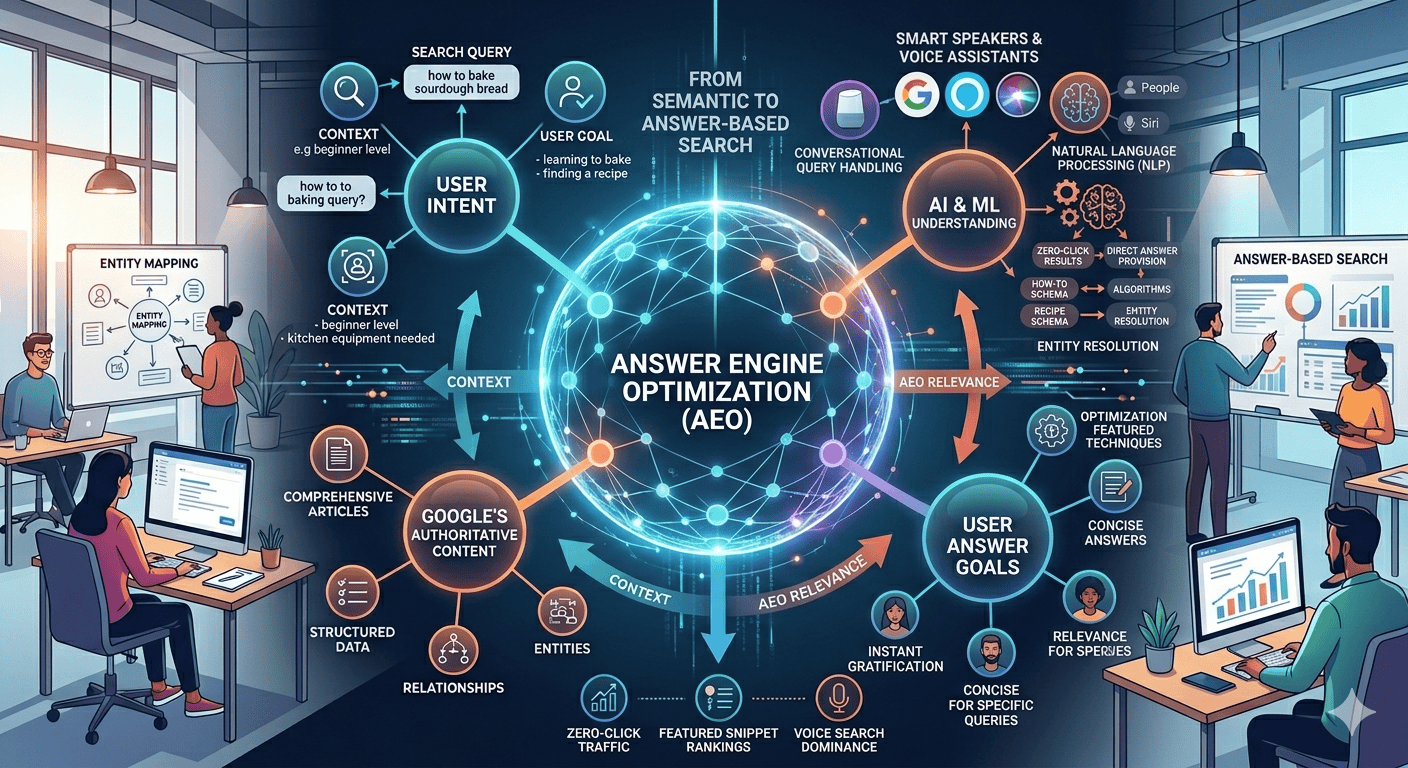
AEO: Answer Engine Optimisation is a layer built on top of SEO, focused specifically on structured, question and answer content optimised for direct answer features, featured snippets, People Also Ask boxes, voice search, and AI Overviews.
GEO: Generative Engine Optimisation is the broadest and most strategic layer. GEO includes brand authority building across the entire web, digital PR, entity optimisation, community presence, and optimisation for how large language models retrieve, interpret, and synthesise information.
| Factor | SEO | AEO | GEO |
|---|---|---|---|
| Focus | Ranking & clicks | Direct answers | AI citations & brand authority |
| Platforms | Google, Bing | Featured snippets, Voice, AI Overviews | ChatGPT, Perplexity, Gemini, Copilot, all AI |
| Success Metric | Rank position, organic traffic | Snippet ownership, zero click presence | Citation rate, Share of Answer, AI brand mentions |
| Key Tactics | Backlinks, on page SEO, technical | Schema, FAQs, structured answers | Entity authority, digital PR, data rich content, llms.txt |
| Content Style | Keyword optimised, long form | Concise, question and answer | Authority first, citation ready, fact dense |
The most competitive Australian businesses in 2026 are running all three layers simultaneously. They are not choosing between SEO, AEO, and GEO, they are stacking them.
How Generative Engines Actually Process Your Content
To win at GEO, you need to understand how AI systems retrieve and synthesise information, because it's fundamentally different from how Google's traditional algorithm works.
When a user submits a query to ChatGPT, Perplexity, or Google's AI Overviews, the AI doesn't simply search for pages that match keywords. It performs what researchers call query fan out, breaking the user's question into multiple sub queries and retrieving content for each one independently.
1. Extractability
Can the AI pull a clean, direct answer from your content without ambiguous or complex language? Structured headings, bullet points, and short answer first paragraphs are highly extractable. Dense walls of text are not.
2. Factual Density
Does your content include specific, verifiable statistics, dates, and named sources? Content with citations and statistics achieves significantly higher AI visibility than unoptimised content.
3. Entity Authority
Is your brand a clearly defined, consistently recognised entity across the web? AI systems cross reference your content against third party mentions, directory listings, review platforms, social profiles, and media coverage.
4. Recency
AI systems that use real time retrieval actively prefer fresh content. Articles with a visible Last Updated date, current statistics, and recent examples outperform older, stale content for time sensitive queries.
5. Technical Accessibility
Can AI crawlers actually access and read your content? Pages blocked in robots.txt, hidden behind JavaScript, or sitting on slow servers with poor Core Web Vitals scores get deprioritised.
The Eight Core Pillars of a GEO Strategy
Pillar 1: Content Architecture Built for AI Extraction
- Open every major section with a direct, 40 to 60 word answer before expanding on it
- Use question style H2 and H3 headings
- Write in clear, simple, conversational language
- Use tables, bullet points, numbered lists, and comparison matrices
- Keep one topic per section
- Add a What changed in year section to perennial articles
The first 200 words of any article are disproportionately important. AI retrieval systems evaluate opening content heavily when deciding whether a page is relevant to a query.
Pillar 2: Fact Density and Original Data
Include a verifiable statistic, named source, or specific data point at least every 150 to 200 words throughout your content. Vague claims are not citable. Specific, attributed claims are highly citable.
- Always cite the primary source directly
- Include the year and context with every statistic
- Link outbound to the original research wherever possible
- Conduct and publish your own original research, surveys, or data analysis
- Update statistics regularly and visibly date stamp your content
Pillar 3: Entity Optimisation
In traditional SEO, you optimise for keywords. In GEO, you optimise for entities, the clearly defined brands, people, concepts, and products that AI knowledge graphs recognise and trust.
- Consistent NAP data across your website, Google Business Profile, directories, and social profiles
- Organisation Schema markup that explicitly defines your brand entity
- Person Schema for key team members and authors
- Wikipedia or Wikidata presence where appropriate
- Crunchbase, G2, Clutch, and industry directory listings
- Consistent brand messaging across all platforms
Pillar 4: Digital PR and Third Party Citations
AI systems heavily weight third party, independent mentions of your brand. A single mention in a respected Australian publication can do more for your GEO standing than multiple self published blog posts.
- Guest articles and expert commentary in Australian industry publications
- Inclusion on best of and top provider lists
- Responses to journalist queries via platforms like Sourcebottle
- Podcast appearances and video interviews
- Press releases via wire services
- Speaking engagements and conference coverage
Pillar 5: Platform Specific Optimisation
Not all AI engines are built the same. Each platform has distinct characteristics that affect what content gets cited and how.
- Google AI Overviews: Pulls from pages already ranking in Google's top organic results and favours structured content.
- ChatGPT: Frequently cites authoritative long form guides, Reddit threads, Wikipedia, and neutral expert authored content.
- Perplexity AI: Prioritises recency, original data, citations, and practical examples.
- Microsoft Copilot: Favours Bing indexed results, step by step guides, and comparison content.
- Google Gemini: Benefits from topical authority, structured headings, and strong entity signals.
Pillar 6: Schema Markup and Technical GEO
Schema markup is the technical backbone of any GEO strategy. It transforms your content into machine readable structured data that AI engines can parse, extract, and cite with precision.
- FAQPage Schema
- Article Schema
- Organization Schema
- Person Schema
- HowTo Schema
- Speakable Schema
- LocalBusiness Schema
Beyond schema, your technical GEO checklist should include:
- Verify that AI crawlers are not blocked in your robots.txt
- Ensure content is server side rendered
- Implement an llms.txt file
- Maintain Core Web Vitals compliance and fast load speeds
- Build clean internal link architecture
Pillar 7: Community Presence and User Generated Content
AI engines are heavily trained on and influenced by content from Reddit, Quora, LinkedIn, YouTube, and review platforms.
- Participate helpfully in relevant Reddit communities
- Maintain a strong LinkedIn Company Page
- Answer questions on Quora with well cited responses
- Build a YouTube presence with educational content
- Engage on industry forums and Australian business communities
Pillar 8: Content Freshness and the GEO Update Cycle
AI engines apply a recency weighting to content, especially for fast moving topics like technology, finance, health, SEO, and AI.
- Run quarterly audits of your highest value pages
- Add a What's Changed in year section to evergreen articles
- Monitor citation decay
- Track competitor citation gains
- Refresh statistics, examples, and outdated information regularly
GEO for Australian Local Businesses
Local and niche businesses often have an enormous GEO advantage over large national brands, particularly for location specific and industry specific queries.
- Build genuinely useful suburb and city specific content
- Keep your Google Business Profile complete and active
- Earn and respond to reviews on Google, Yelp, and industry platforms
- Implement LocalBusiness schema with your full Australian address, ABN, trading hours, and service area
- Get listed in local news outlets, community websites, and industry associations
- Create content that answers questions specific to your local market
Measuring GEO Performance
- AI Citation Monitoring: Query ChatGPT, Perplexity, Gemini, and Copilot with your target queries and track citations.
- Google AI Overviews Impressions: Monitor AI Overview impression data in Google Search Console.
- AI Referred Traffic in GA4: Track sessions from ChatGPT, Perplexity, and other AI platforms.
- Share of Answer: Track how often your brand appears in AI generated answers compared with competitors.
- Branded Search Volume: Monitor increased brand demand caused by AI visibility.
- Featured Snippet and PAA Ownership: Use these as strong GEO proxy metrics.
Common GEO Mistakes to Avoid
- Blocking AI crawlers
- Publishing content with no original data
- Ignoring third party presence
- Leaving old content stale
- Not creating an llms.txt file
- Writing only for Google instead of conversational AI queries
- Using inconsistent entity signals across the web
The GEO Roadmap: Where to Start in 30, 60, and 90 Days
Days 1 to 30: Foundation Audit
- Verify AI crawlers are not blocked in robots.txt
- Implement or audit schema markup
- Create or update your llms.txt file
- Audit your top 10 content pages for answer clarity and fact density
- Set up GA4 tracking for AI referral sources
- Run manual citation checks across key AI platforms
Days 31 to 60: Content Optimisation
- Restructure top performing pages with answer first openings
- Add or update statistics and source citations
- Refresh any content older than 12 months
- Begin a topic cluster build around your core service areas
- Launch a digital PR push targeting relevant Australian publications
Days 61 to 90: Authority and Community Building
- Establish or optimise your presence on Reddit, LinkedIn, and Q&A platforms
- Submit or update listings on Clutch, G2, Trustpilot, and Australian directories
- Begin a quarterly content refresh calendar
- Implement GEO tracking dashboards
- Review competitor citation patterns and identify gaps
Frequently Asked Questions About GEO
What does GEO stand for?
GEO stands for Generative Engine Optimisation. It is the practice of structuring content and building brand authority so that AI powered platforms cite and recommend your content in generated answers.
Is GEO the same as AEO?
They are closely related but not identical. AEO focuses on structured question and answer content for direct answer features, while GEO is broader and includes entity authority, digital PR, community presence, and platform specific optimisation.
Does GEO replace SEO?
No. GEO builds on top of SEO. Strong traditional SEO is the prerequisite because AI systems need to find and trust your content before citing it.
How quickly can GEO produce results?
Brands that restructure existing high authority content using GEO principles typically see results within 60 to 90 days. New content on a fresh domain takes longer.
What tools can I use for GEO?
Key tools include Semrush, Ahrefs, Google Search Console, Similarweb, AnswerThePublic, Schema.org, Google's Rich Results Test, Profound, and DOJO AI.
Is GEO relevant for small Australian businesses?
Absolutely. In many local and niche verticals, small businesses that move early face very little GEO competition.
Final Word: The Citation Economy Has Arrived
We are in the early stages of what some are calling the Citation Economy, a search landscape where brand visibility is determined not by where you rank, but by whether AI systems trust you enough to recommend you.
For Australian businesses, the opportunity is real, immediate, and, for most industries, still wide open. Most of your competitors haven't started. The citation share you build now will compound over time, just as domain authority did in the early days of SEO.
At The SEO Pros, we help Australian businesses build the technical foundations, content architecture, and brand authority needed to win in the AI search era.
Talk to our team today, and let's make sure your brand is part of every AI answer that matters to your business.